


On Wednesday, November 25, 2026 we hosted our first Marble Live: 20 minutes on what changed in Marble this year and a Q&A. The theme was Connections: revealed. Its keystone feature: the user graph, our new visual link analysis tool for FRAML investigations.
Why a live showcase?
Because your feedback shaped much of what you’ll see below, and this is how we keep that loop open.
Marble is built on an open-source core, and we build in the open: you can read our code, follow our releases, and now watch us walk through them, live and unscripted where it counts.
Therefore, Marble Live is the logical next step. Twice a year, we’ll show you what we shipped, explain why we built it the way we did, and take your questions on air. Even the hard ones.
Missed it, or want a second look? Here is the full recap, with every demo clip.
Why “Connections: revealed”
Financial crime rarely stems from just one account. It is usually orchestrated through networks.
In 2023, the Bank for International Settlements tested a simple idea in Project Aurora, a proof of concept on simulated payment data. The same data, but two ways to look at it.
Customer by customer, with rules: the analysis found up to 25% of the money launderers.
But when they used models that looked at behavior and connections, they found more than twice as many. And the network model raised 40% fewer false alarms than the rules.
The same data with a better view leads to better decisions.
That's why we opened our first Marble Live with one question: can you see the network behind a customer?
Seeing the network takes three things:
- knowing every customer in it,
- watching the connections that matter, and
- investigations that keep up.
That's how we build Marble, so that's how we walked you through what we shipped this year.
Customers: never out of sight
Traditionally, customers are assigned a score based on their behavior to assess their risk level.
But a risk score is only as good as its last update.
This year, Marble’s customer risk scores became fully automatic. Every time a customer’s data changes or a list updates, the customer risk score is automatically re-calculated.
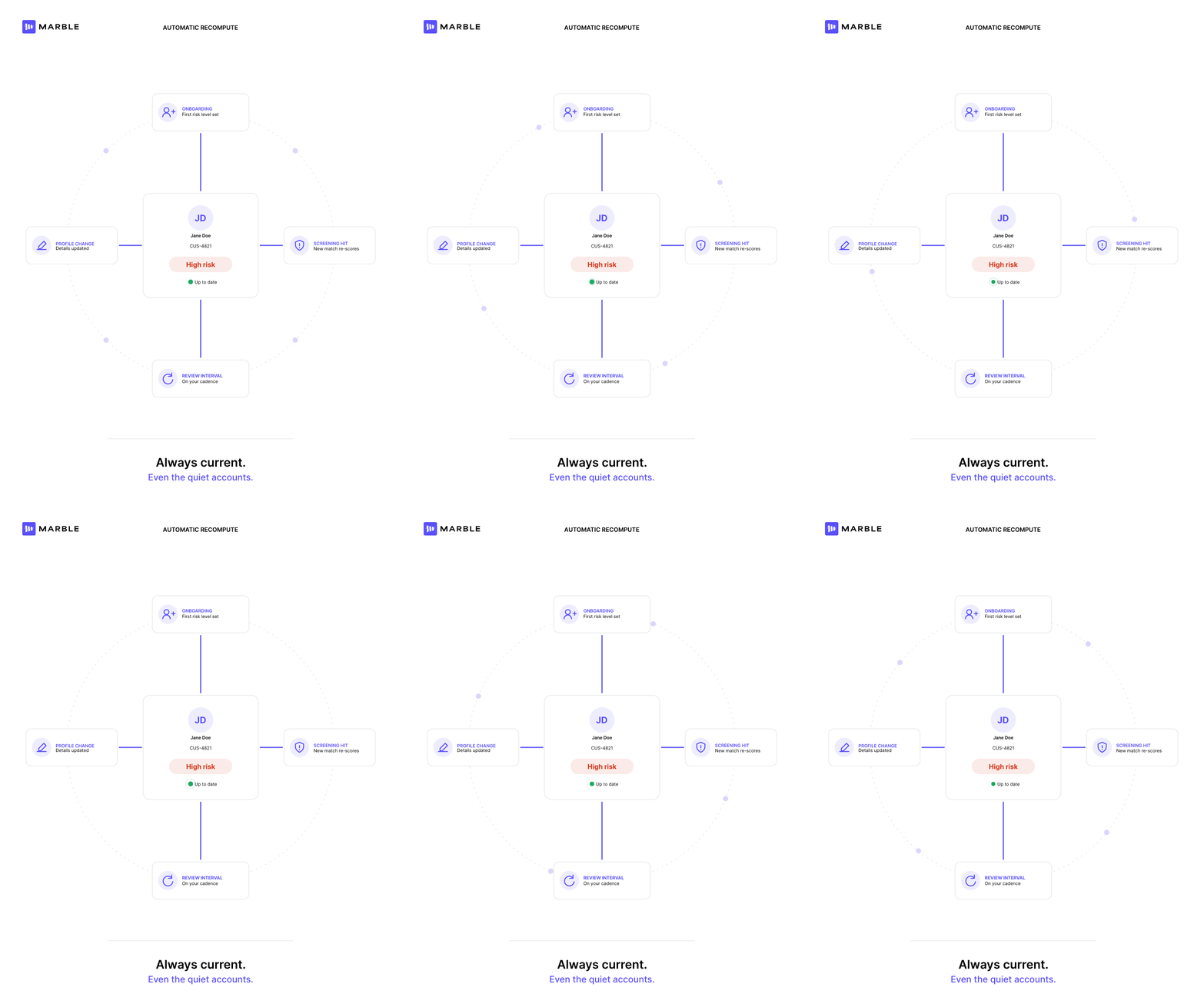
Click a score and you see exactly how it was calculated: every factor, and how much it counts. No black box. You can show it to an auditor as it is.
Before you change your scoring model, you can now test it. One click runs a backtest on your existing customers: who changes risk level, in which direction, and exactly who they are. Then you publish the change, or adjust it and test again.
Nevertheless, an up-to-date risk score is only half the picture. Keeping every customer in focus also means checking them against the latest watchlists using data you can trust. And making sure every team acts on the same view. That’s what two other releases from this year do:
- LexisNexis WorldCompliance data now runs fully on-premise, giving you premium screening data without it ever leaving your own infrastructure
- And webhooks tell your other systems the moment a customer’s risk level changes, so payment limits, KYC refreshes, and account teams all work from the same risk view as compliance
Rules you write yourself
The connections that matter to a payment FinTech aren’t the ones a bank watches. A generic rulebook fits neither.
But creating a fully custom set of detection rules in legacy tools is very time-consuming, complicated. Ultimately, very expensive. So many financial institutions adopt their needs to what the tools offer.
Marble does the opposite: Marble adapts to your needs, not the other way around.
To achieve this, now in Marble, writing a rule is now as simple as describing it. Any compliance or FRAML can do it on their own, without coding or filing a ticket with IT.
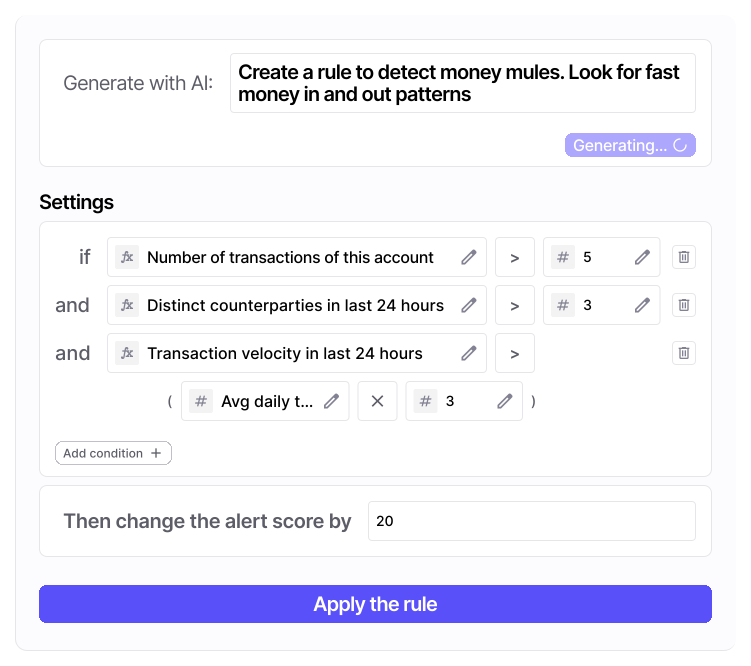
Start from the AI rule catalog: ready-to-use rules, each with a clear description written by AI, so the whole team understands what a rule does, not only the person who built it. Adapt the threshold, the time window, and the fields to your own data. Need something new? Describe it in plain language and review the logic Marble builds. Compare versions before you publish.
No ticket. No developer. No waiting.
Writing your own rules only pays off if they can see what matters to you, and run reliably at your scale. Three other releases from this year make sure they do:
- Rules can now use IP data. Thanks to this, you can watch logins from an unexpected country, or several accounts acting from the same address. This allows you and your team to spot connections behind transactions
- Rules can also use your customer risk scores. So you can set tighter thresholds for high-risk customer than for low-risk ones, all within the same scenario
- And batch scenarios, the scheduled runs that sweep across your whole customer base, now pick up where they stopped after an interruption instead of starting over. Your largest checks finish without gaps in the record everytime
Investigations that keep up
When a sanctions list changes, one update can create hundreds of hits overnight.
Most are false positives. Yet, every one still needs a review to make sure your institution remains compliant.
Our new screening review puts them all on one screen. Your assigned hits sit in one queue, grouped by customer. Select a hit, and your customer and the list record appear side by side, field by field: same, close, different, or missing. Validate, and the next hit opens automatically. Move through the queue with your keyboard, clear false positives in batches, and undo a decision when you need to.
Hundreds of hits. One screen. Your decision on every single one.
The new screening review is coming to Marble very soon.
Reviews only keep up if the whole workflow around them does. Three releases from this year already make sure of that:
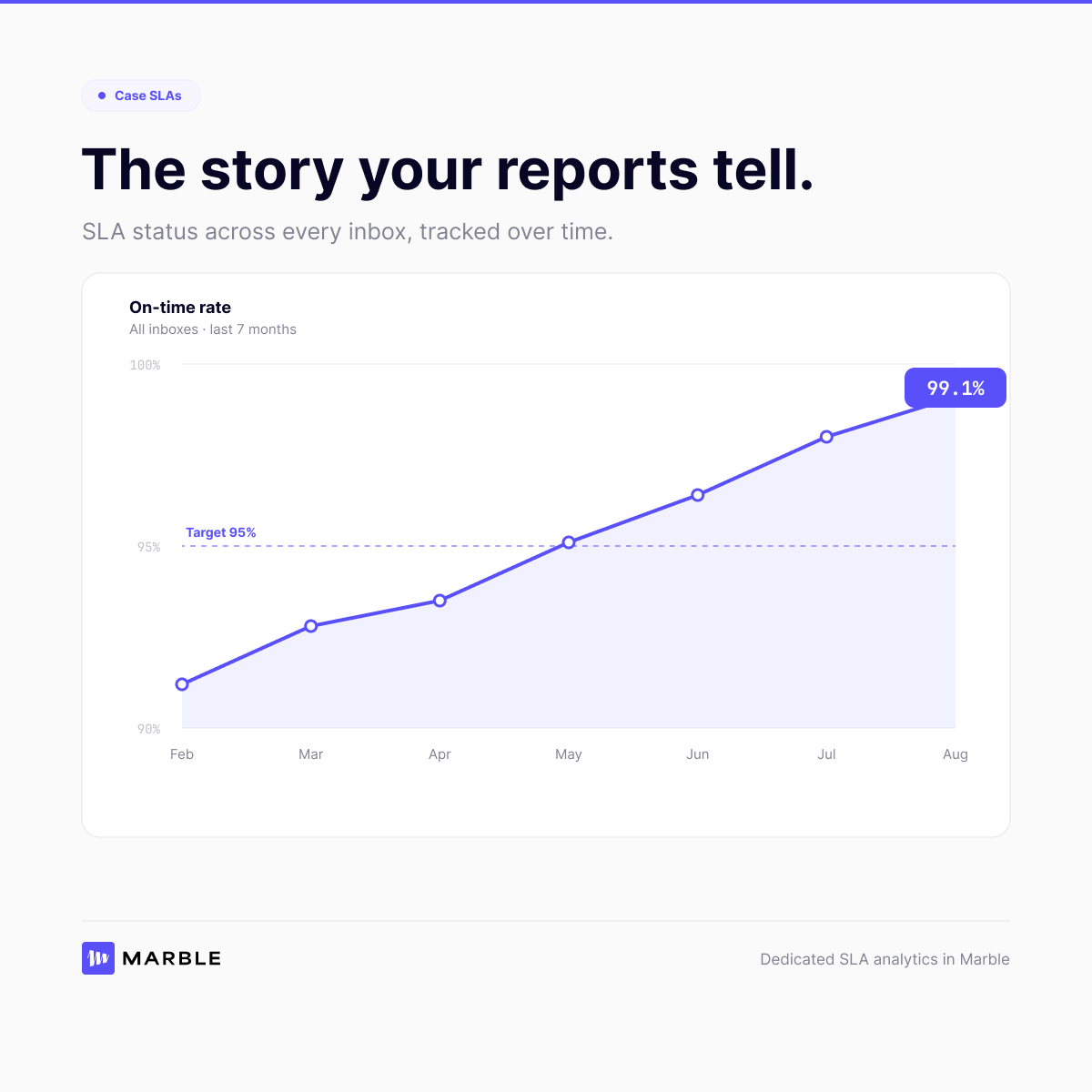
- Case SLAs give every case a deadline based on your own policy, with the time left visible right in the list. SLA analytics then show how many cases close on time, where they slow down, and which teams need support, which is proof you can hand straight to an auditor
- The redesigned case manager brings everything an analyst needs to decide into one clearer view. And batch reviews now offer “Do not alert again”, with an optional comment. When you clear several false positives at once, they stay cleared, and the same match doesn’t come back with the next list update
Compliance AI in every step
Then we followed one alert from the rule to the report, to show where compliance AI now takes on the legwork:
- Rules: written in plain language
- Screening: an AI suggestion on each hit, with the level of likelihood
- Investigation: a first AI review of every case, with an estimated risk level, your own review instructions, a case summary, and web search with sources
- Reporting (coming soon): a first draft of the suspicious activity report, which the analyst edits and approves
Three things stay in your hands:
- You can bring your own AI provider
- Every suggestion is explained and logged, ready for your auditor
- And nothing is filed or closed without a human being deciding on it
The busywork is automated away. Every decision stays yours. Always.
Why we build compliance automation this way
Arnaud Schwartz, our co-founder and CEO, explained the thinking behind it. In September, Marble raised a €6.5M Series A, led by Smartfin, to make compliance automation the standard, not the exception. That means automation that explains itself and leaves the decision to the expert.
But automation is only as good as the data behind it. Fraud and money laundering are not two problems. They are one fight: FRAML. And this one fight needs one connected view.
More than 100 institutions in over 25 countries use Marble today, and much of what we showed started as their feedback.
The keystone feature: introducing the user graph
That connected view is the user graph, Marble’s new visual link analysis tool.
Open a case and the graph is already there, centered on your customer. It shows direct links (who owns what, who paid whom) as well as hidden ones: two customers who never transacted, but share a device, an IP address, or an IBAN. Every node shows its risk level. Every link has a reason you can click and trace back to your customer. And you decide which links count, once, in your own data model.
The library behind it, ego-graph, is open source because Marble builds in the open: we believe that transparency and trust go hand in hand.
What’s next
- The next Marble Live: spring 2027 as we seek to make Marble Live into a twice-a-year event
- The AMLR: it applies on 10 July 2027. The new rulebook is built to change, and your rules should keep pace
- The user graph: next, we’re bringing network signals into how Marble screens and scores your customers
Everything we shipped in 2026 in brief
Customers: continuous screening · customer hub · LexisNexis data, on-premise · saved manual searches · customer risk assessment API and webhooks · visible score calculations · one-click scoring backtest · customer KPIs
Rules: rules in plain language · IP and risk score data in rules · AI-written rule descriptions · batch scenarios that resume · AI rule catalog · new aggregate filters
Investigations: redesigned case manager · case SLAs and SLA analytics · “Do not alert again” in batch reviews · the user graph
AI: AI suggestions on screening hits · AI first review of every case · your own review instructions · case review summaries · web search enrichment · bring your own AI provider
Coming soon: the new screening review · AI report drafting
See it on your own data. Marble clients: book a working session with Alexandre to turn on what you saw. Not a client yet? See the demo yourself or talk to an expert.
