


Often, regulatory change usually arrives in one of two shapes. Sometimes it is a deadline: AMLR hands European banks a fixed date and a countdown. Sometimes it is a standard imported and adapted to local conditions (which is the pattern behind Malaysia's approach to sanctions screening). Monaco is neither – and that is what makes it exciting and worth a closer look. The Principality did not simply rewrite its rules – it rebuilt the institution that enforces them. That makes Monaco AML compliance one of the more instructive regulatory stories in Europe right now, because it tests a question the other two do not:
what actually changes when a jurisdiction replaces its supervisor?
Search for guidance on Monaco AML compliance and you will find a great deal of it.
But much of it still describes a supervisor that no longer exists in that form. SICCFIN (Service d'Information et de Contrôle sur les Circuits Financiers) stopped being Monaco's AML supervisor in 2023. What replaced it is a different kind of institution with a different set of powers.
And that change explains more about how supervision now works in the Principality than the grey listing does.
If your view of the Monegasque framework was formed before mid-2023, it is worth updating. A lot has happened since. Here is what actually changed, and what it asks of a compliance function.
From SICCFIN to AMSF: the structural AML shift guidance missed
On 6 July 2023, Law No. 1.549 transformed SICCFIN into the Autorité Monégasque de Sécurité Financière, the AMSF.
The renaming is the least interesting part. Three things moved with it.
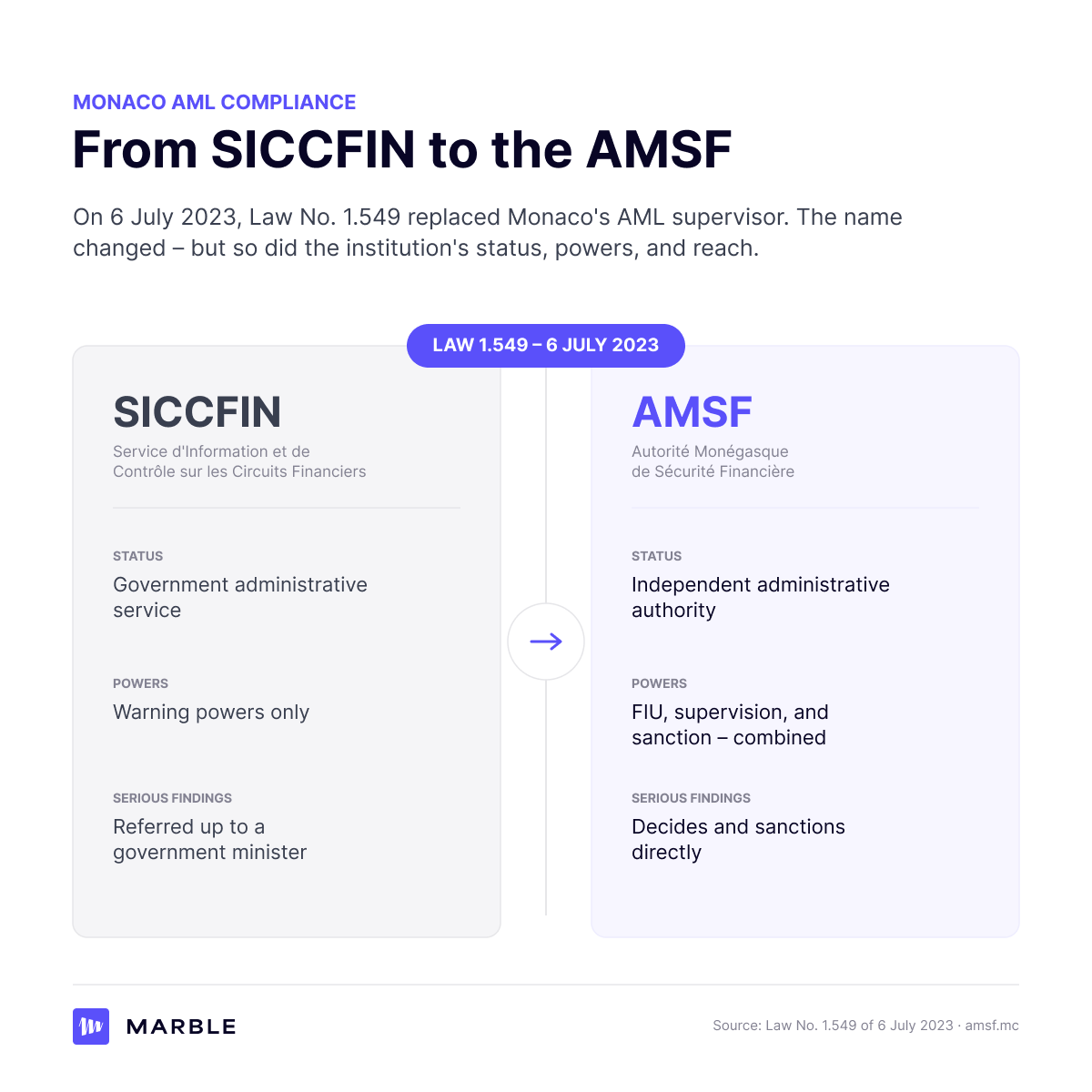
- The status changed: SICCFIN was a government administrative service inside the state apparatus. The AMSF, however, has become an independent administrative authority.
- The powers consolidated: the AMSF now combines the financial intelligence unit function, AML/CFT supervision, and sanctioning in a single body. Those roles were previously in different places.
- The sanctioning power moved: this is the one that matters. Under the old arrangement SICCFIN inspected but could not sanction at all. Findings passed to a review commission, which proposed a sanction to the Minister of State, who decided (and was not bound by the proposal – MONEYVAL found the resulting process took between two and five years from inspection to sanction). But today, the AMSF holds that power itself.
A supervisor that has to refer a case to a minister behaves very differently from a supervisor that can decide on it. The mechanism has become more powerful.
Why the AMSF transition matters more than the FATF grey list
Monaco was placed on the FATF grey list in June 2024, and the story since has been told largely through that lens: a jurisdiction working through an action plan, filing progress reports, moving toward exit.
That framing is accurate. Yet, it is incomplete. It describes the agenda without describing the instrument.
The grey listing set the priorities – and Law 1.549 supplied the means.
The enforcement actions that followed in 2025 and 2026 were extensive: multi-million-euro penalties against regulated institutions for customer due diligence failures, weak politically exposed person (PEP) onboarding, and unverified source of funds on large cross-border transfers.
Read separately, the fines look like a response to international pressure. Read together, they look like a supervisory system doing what it was rebuilt to do.
The practical consequence for a compliance function is that this doesn’t reverse. International pressure recedes. Institutional architecture does not.
What the AMSF examines during AML inspections in Monaco
Definitional summaries of the AMSF are easy to find. Operational ones are less so. Based on the pattern visible in published enforcement and in the authority's own guidance, five areas emerge:
- Source of funds and source of wealth: the most consistently cited failure. Not whether a file contains a source-of-wealth narrative, but whether that narrative is evidenced, corroborated, and re-examined when circumstances change. In a market built on internationally mobile private wealth, this is the highest-risk control. And the one most often found wanting.
- PEP onboarding: Monaco's client base is unusually PEP-dense. This makes PEP handling of primary importance. Expectations extend past list-matching to PEP-by-association, adverse media, and the judgment recorded at the point of acceptance.
- Ongoing monitoring of cross-border flows: private-wealth transaction patterns are large, infrequent, and international – nothing like the retail patterns most monitoring is calibrated for. Enforcement has repeatedly cited the purpose of large transfers into sensitive jurisdictions going unexamined. This is what regulators have set out to change.
- Ultimate beneficial ownership (UBO) resolution: Monaco maintains a beneficial ownership register. But a register is a declaration rather than a verification. Nominee arrangements, layered structures, foundations, and trusts still have to be unwound by the institutions themselves, one by one.
- Evidence and remediation follow-through: the most telling development. Multiple enforcement decisions have concerned findings that had already been sanctioned previously. This means that the supervisor returned and checked whether the fix was actually applied. That converts remediation from a project into a record you have to be able to produce.
The current framework
For reference, the current legal architecture:
- Law No. 1.362 of 3 August 2009, on the fight against money laundering, terrorist financing, and corruption, remains the principal statute, accompanied by
- Sovereign Ordinance No. 2.318 of 3 August 2009.
It has been amended repeatedly. Reforms in 2020, 2021, and 2022 brought Monegasque obligations into line with the
- European Union's fourth (AMLD4) and fifth (AMLD5) AML directives, tightening enhanced due diligence for atypical transactions and for counterparties connected to high-risk states, strengthening correspondent banking requirements, and introducing professional certification for AML managers.
- Law No. 1.549 of 6 July 2023 created the AMSF.
- Law No. 1.559 of 29 February 2024, adapted the framework further, as part of the legislative response to MONEYVAL's findings.
Subsequent reform has widened the perimeter rather than the depth: UBO obligations extended to associations and foundations, supervision of designated non-financial businesses and professions strengthened, and the real-estate professions brought into a reformed regime.
The direction is consistent: more of the economy inside the framework, and a supervisor equipped to examine it.
What this asks of a compliance function
None of the above asks for more effort. Monaco's compliance teams are not under-trying. They are being asked to produce something structurally different from what most systems were built to produce.
The old standard was about having controls.
The current standard is being able to demonstrate that controls operated – on a named file, on a named date, with the evidence attached and the reasoning recorded.
That distinction shows up in three places:
- Source-of-wealth work has to move from narrative to evidence. A free-text summary written at onboarding and never revisited is not a record; it is a recollection. What holds up is structured, corroborated, and re-verified when something changes.
- Screening has to be tuned for the book it actually serves. A PEP-dense, internationally exposed client base generates volume that a generic configuration turns into noise, and noise is where genuine findings get lost.
- And remediation has to leave a trail. If a supervisor can return to a previous finding and ask whether it was fixed, then the answer has to exist as documentation rather than as institutional memory.
This is where AML compliance software earns its place – or fails. A platform that produces alerts but not defensible records solves the easier half of the problem. What a compliance team needs is the case, the evidence, the decision, and the audit trail held together. So that what happened is reconstructible a year later. Even by someone who was not there at the time.
What happens in Monaco AML compliance after FATF grey list removal
By mid-2026 the FATF had concluded that Monaco substantially completed its action plan, with an on-site assessment remaining before removal from the grey list can be considered.
When that happens, it is worth being clear about what changes and what does not.
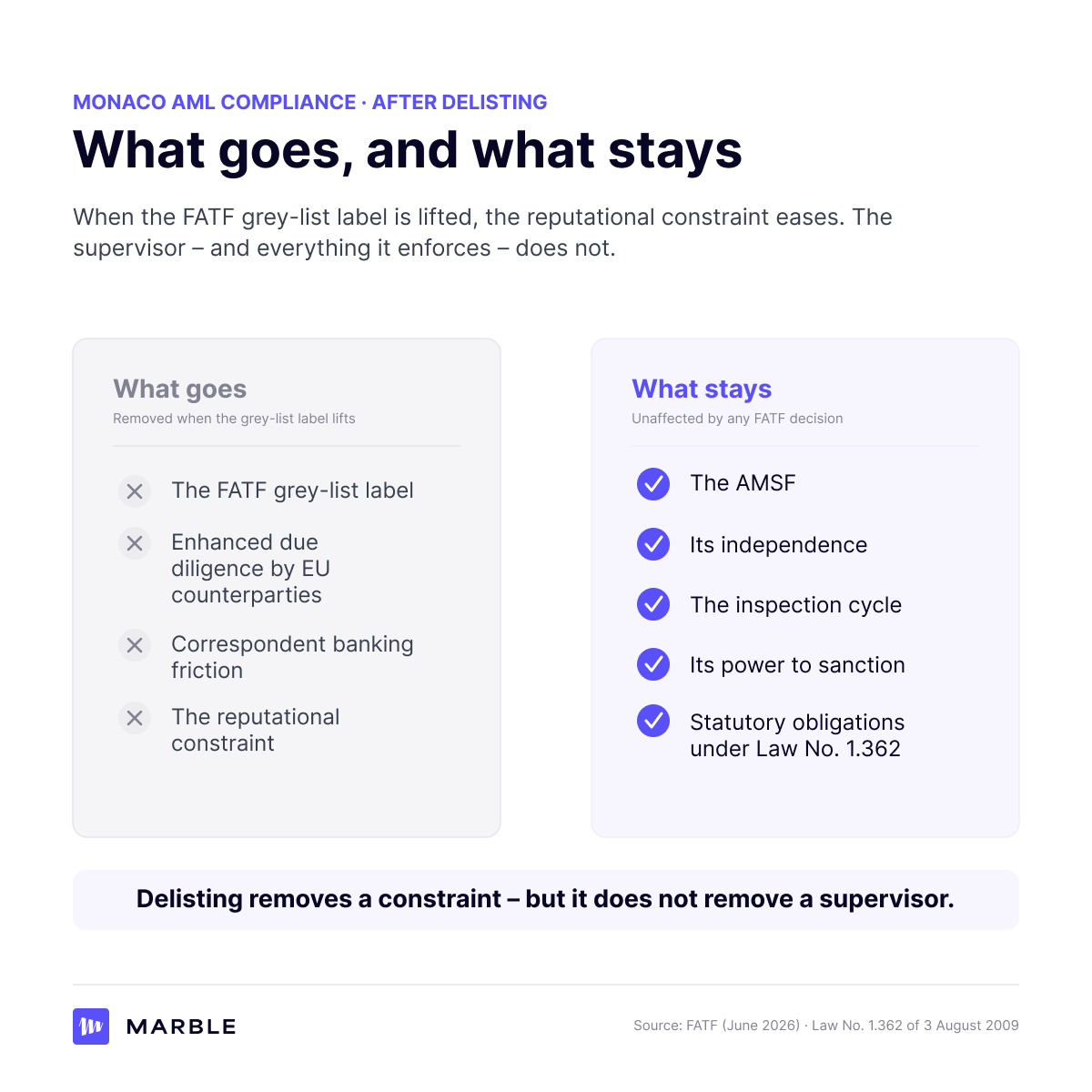
- The label goes. The enhanced due diligence that EU counterparties apply to Monaco-linked business eases. Correspondent banking friction reduces. Those are real gains and they are the reason the exit matters commercially.
- Yet, the AMSF does not go. Its independence, its supervisory programme, its inspection cycle, and its power to sanction will be unaffected by any FATF decision. The statutory obligations, the changes in Monegasque law will also stay.
An eventual delisting would remove a reputational constraint. But it does not remove a supervisor. Compliance functions planning for the period after exit should plan for the supervision they have, not the pressure they are losing.
Marble works with financial institutions on exactly these controls. If you'd like to talk it through, book time with our experts.
Frequently asked questions
Who regulates AML compliance in Monaco?
The Autorité Monégasque de Sécurité Financière (AMSF). It is an independent administrative authority that combines three roles in one body: financial intelligence unit, AML/CFT supervisor, and sanctioning authority. It has held its own power to sanction since 2023.
What happened to SICCFIN?
SICCFIN was replaced by the AMSF under Law No. 1.549 of 6 July 2023. It was a government administrative service; the AMSF is an independent authority with broader powers. Guidance published before mid-2023 describes an arrangement that no longer applies.
What is Monaco's main AML law?
Law No. 1.362 of 3 August 2009, on the fight against money laundering, terrorist financing, and corruption, together with Sovereign Ordinance No. 2.318 of the same date. It was amended in 2020, 2021, and 2022, and again by Law No. 1.559 of 29 February 2024.
Is Monaco in the EU, and does EU AML law apply directly?
No. Monaco is not an EU member state, so EU directives and regulations do not apply directly. Monaco has nonetheless aligned its framework closely with successive EU AML directives, which is why the obligations will look familiar to anyone working under EU rules.
Is Monaco on the FATF grey list?
Monaco was added in June 2024. In June 2026 the FATF concluded that Monaco had substantially completed its action plan, with an on-site assessment remaining before removal can be considered. (Review after each FATF plenary.)
Does grey listing mean sanctions against Monaco?
No. The FATF does not call for sanctions or countermeasures against jurisdictions under increased monitoring. The practical effect is that counterparties elsewhere apply enhanced due diligence to Monaco-linked business, which shows up as slower processing and heavier documentation rather than restricted flows.
Is Monaco also on the EU list of high-risk third countries?
Yes. The European Commission added Monaco in July 2025, largely as a consequence of the FATF listing. The effect is that EU obliged entities must apply enhanced due diligence to business involving Monaco.
Can the AMSF fine firms directly?
Yes. Since the 2023 reform the AMSF decides sanctions itself rather than referring them upward, and it has imposed administrative fines on both financial institutions and non-financial businesses for AML failures.
Which businesses are covered by Monaco's AML rules?
Considerably more than banks. The perimeter includes management companies, corporate service providers, trustees, insurers, real-estate professionals, and dealers in high-value goods. Recent reform has widened this perimeter rather than deepening obligations on banks alone.
