


Compliance reporting is the step every team dreads. Not because the work is complex – but because so little of it requires actual judgment.
Copy-pasting case facts. Reformatting investigation notes. Cross-checking fields before filing. Hours of effort – that produce no analytical value. But it leaves so much room for error.
Artificial intelligence (AI) doesn't replace the compliance officer. It removes the busywork for them – so the judgment that actually matters gets the space it deserves.
Key takeaways:
- Most compliance reporting delays come from manual, mechanical tasks – not analytical complexity
- AI should compile evidence, draft summaries, and pre-fill filings; humans must review, decide, and sign off
- A complete audit trail is non-negotiable: every action logged, timestamped, and unalterable
- The right compliance reporting tool fits your workflow – it doesn't replace it. And it’s certainly not you and your team who should adjust. Your tool should adapt to your work
The compliance reporting workflow
A complete reporting workflow has four stages, each with its own demands.
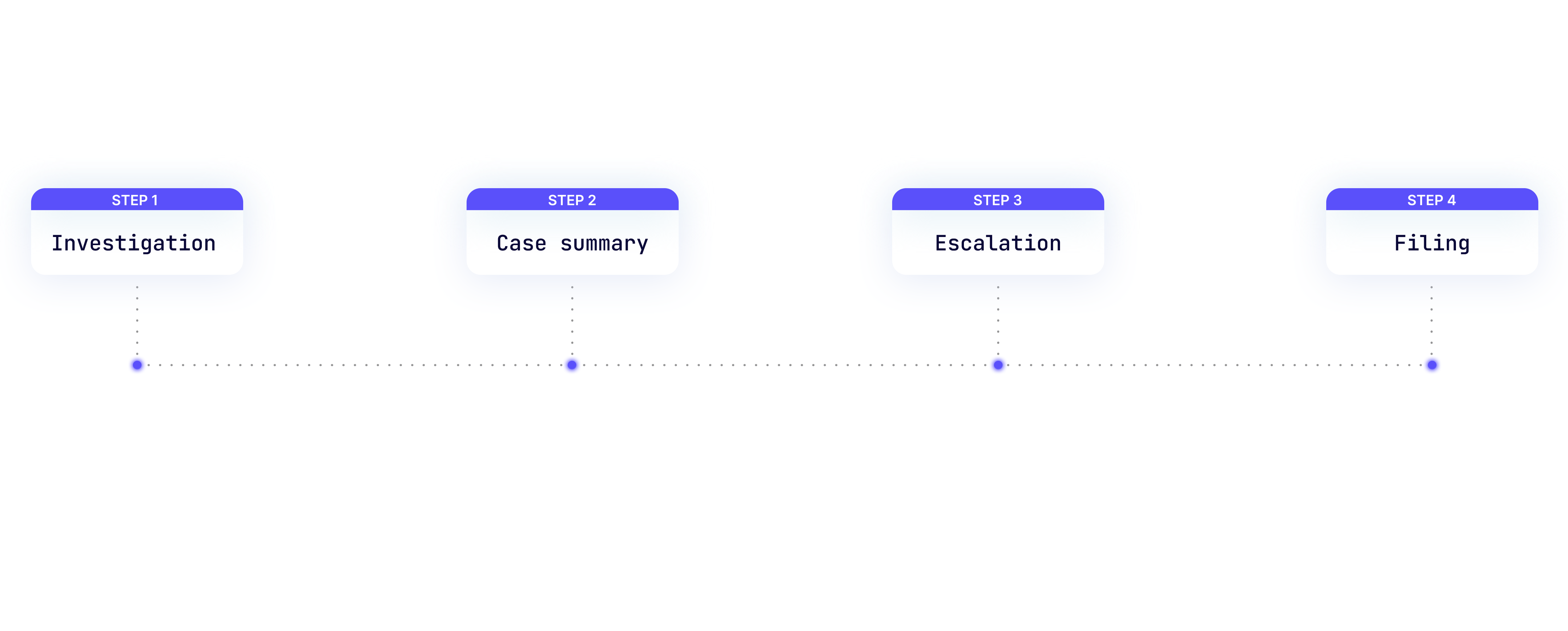
- Investigation
Alerts are triaged, evidence gathered, and a case built. This is where analysts spend most of their time – and where the quality of the final report is determined. Errors or gaps here compound every subsequent step - Case summary
Findings are compiled into a coherent narrative. Risk rationale is documented. Supporting evidence is linked. This step is routinely done manually, from scratch. Even when 80% of the content already exists in the case file - Escalation
Higher-risk cases are routed to senior reviewers or compliance officers. Without a structured escalation process, this step creates bottlenecks and inconsistency across the team - Filing
Suspicious activity reports (SARs) or other regulatory filings are completed and submitted. Pre-filling fields from case data is possible in principle. In practice, most teams still do it by hand
Each stage is sequential. So a delay or error in one compounds the next.
Where reporting breaks down – and what you can do with AI to fix it
The failure points are consistent across teams and institutions.
The four most common breakdowns
- Copy-pasting case facts
Analysts re-enter information that already exists in the case manager. It's tedious. Slow. It introduces errors. And it adds zero value - Missing or fragmented context
Evidence scattered across alerts, transaction histories, and entity profiles. All these data don't automatically assemble itself into a coherent narrative. Without a tool that surfaces it in one place, analysts piece it together manually. Bit by bit. And they sometimes miss something. Potentially something important - Inconsistent formatting and structure
Reports filed by different analysts look different. Sections are in different orders. Risk rationale is phrased differently. Regulators notice – carefully built trust erodes - No version control
Edits are made without a clear record of who changed what, and when
What AI should handle
AI should compile evidence automatically from the full case file. Then draft structured summaries based on established risk rationale, pre-fill SAR fields from verified case data, and flag gaps before the analyst reviews.
What AI should not do is decide.
It should not determine whether a filing is warranted, assign final risk ratings without human review, or remove any step that requires a compliance officer's sign-off.
The record needs to show that a qualified human made the call – every time.
The line AI should never cross
This distinction matters, and it's worth stating clearly.
AI as an in-depth analysis tool, not decision-maker
AI in compliance reporting surfaces evidence, enriches the context, structures information, and reduces the mechanical load. So that an in-depth analysis is ready for compliance review – everything relevant in one place at the right time.
The compliance officer reviews the draft analysis, all the relevant context and proofs, applies judgment, and approves the filing.
This isn't a limitation of the technology. It's the correct procedure. Regulators – and ultimately, customers – expect human accountability at every step.
An audit trail that shows "AI filed this" is not an audit trail. It's a liability.
What good design looks like
The best AI compliance reporting systems make the human's job faster and better-informed. The analyst arrives at the review stage with a complete, structured draft – not a blank page. The decision is still theirs. The record shows it.
How Marble handles AI compliance reporting
Marble's AI Virtual Analyst is built around this principle:
automate the structure, preserve the judgment
Surfacing proofs
Marble compiles full case evidence: alerts, investigation notes, transaction histories, entity profiles. It surfaces everything relevant in one structured view, ready for review.
Nothing is missed. Nothing needs to be manually gathered.
AI-drafted risk summaries and SAR pre-filling
From the compiled case, Marble's AI Virtual Analyst drafts risk summaries and pre-fills SAR fields directly from verified case data.
Analysts review, refine, and add reasoning. No reformatting. No copy-pasting. No starting from a blank page.
Structured escalation and workflow routing
Escalation is built into the workflow. Cases route to the right reviewer based on your procedure. Every handoff is logged. Consistency is enforced without additional oversight overhead.
Unalterable audit trail
Every action is timestamped and unalterable – so the audit trail is complete before you even think about it. Search it by decision, by analyst, by case, or by date. When regulators ask, the record is already ordered.
Role-based access control
Role-based access control (RBAC) means the right people see the right information. Senior reviewers see what they need. Analysts work within their remit. Regulators see a clean record that proves your process without lengthy reconstruction.
The result: filings that are faster, more consistent, and fully defensible.
Start improving your compliance reporting workflow
Compliance reporting doesn't have to be the bottleneck it is for most teams. The mechanical steps – gathering evidence, drafting summaries, formatting filings – are solvable. What's left is the work only your team can do: review, judgment, sign-off.
Marble is built to draw that line clearly.
See how Marble handles compliance reporting →
Frequently asked questions about AI compliance reporting
What is AI compliance reporting?
AI compliance reporting uses artificial intelligence to automate the mechanical steps in the regulatory reporting process – compiling evidence, drafting case summaries, and pre-filling filing forms. Human compliance officers review, refine, and approve every filing. AI handles the structure; humans make the decisions.
Can AI automate SAR filing?
AI can pre-populate SAR fields from verified case data, draft risk narratives, and flag missing information before submission. The filing itself – the decision to report and the sign-off – must remain with a qualified compliance officer. Full automation of SAR filing without human review is not compliant with regulatory expectations.
How does AI reduce errors in compliance reporting?
By eliminating manual re-entry of case data, AI removes the primary source of transcription errors. Structured templates enforce consistency across filings. Evidence is compiled from the case record automatically, reducing the risk of missing context. The result is more accurate filings with less analyst effort.
What should an AI compliance reporting audit trail include?
Every action in the reporting workflow – evidence gathered, drafts created, edits made, approvals given, and filings submitted – should be logged, timestamped, and unalterable. The trail should identify who took each action and when. Regulators need to reconstruct your decision-making process from the record alone.
How is Marble different from other compliance reporting tools?
Most reporting tools are passive – they store records but don't help generate them. Marble's AI Virtual Analyst actively compiles evidence, drafts summaries, and pre-fills filings from live case data. Combined with role-based access control (RBAC) and an unalterable audit trail, it covers the full reporting workflow in one place.
