


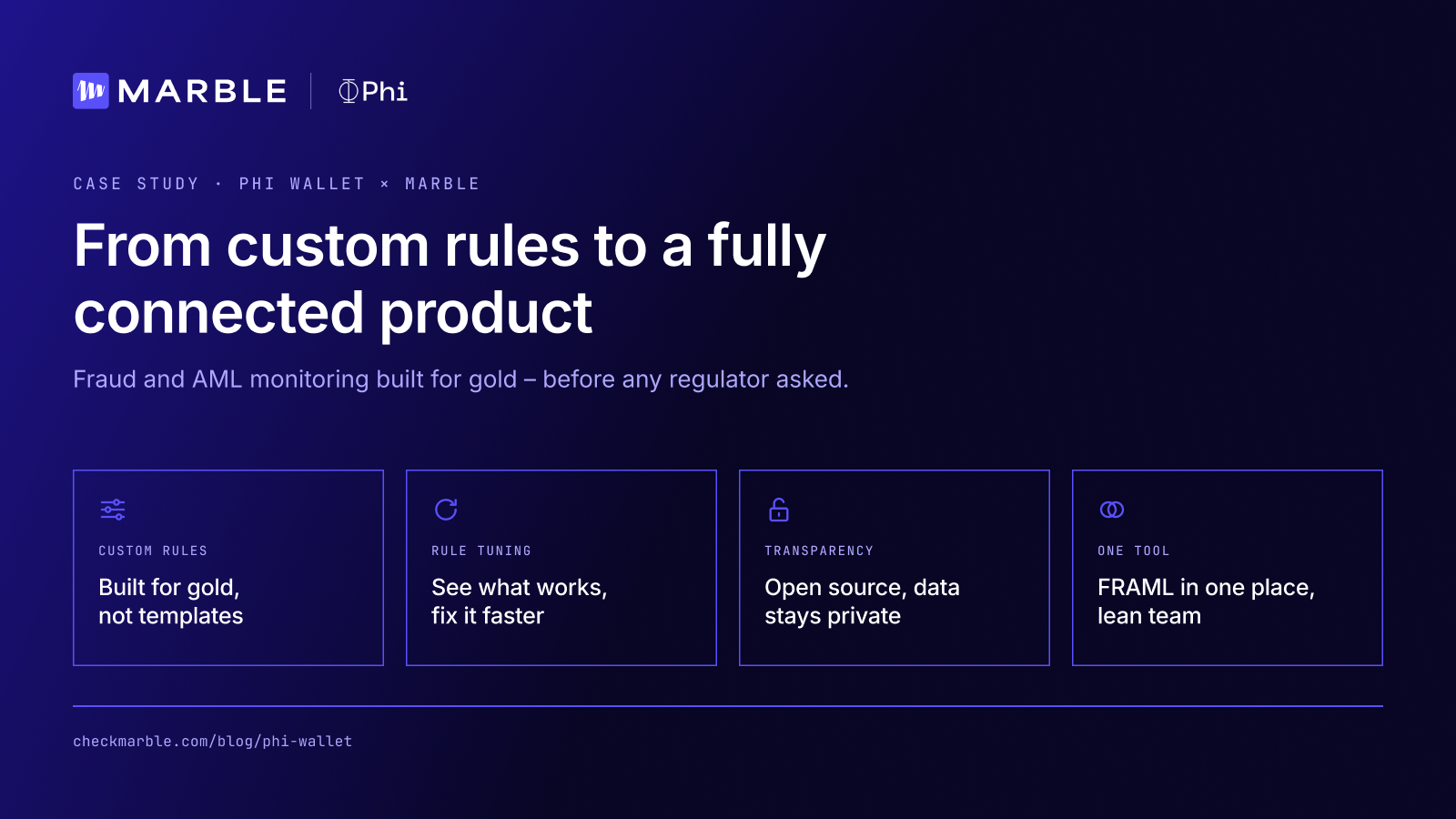
A gold savings app put Marble at the center of its risk setup before any regulator asked. They gained faster rule tuning, monitoring that no legacy template allows, full data transparency, and a leaner team.
{{quote1}}
At a glance
- Client: Phi Wallet, a Portugal-born global FinTech that lets anyone buy, save, and sell LBMA-certified physical gold from their phone, from €1
- The challenge: Build tailored fraud and anti-money laundering (FRAML) monitoring before licensing, for an asset whose transaction patterns and amounts break off-the-shelf templates. All without compromising user data
- The solution: Marble's platform at the core of Phi Wallet's risk setup: custom rules, risk scoring, and scenarios built on the company's own data
- Key results:
- Custom rules built for gold; proactive scenarios on demand
- Faster rule tuning, run by Phi Wallet's own team
- Full transparency, without compromising user data privacy
- FRAML in one tool, run by a lean team
Compliance first, before any regulator asked
Phi Wallet lets anyone buy, save, and sell physical gold from their phone. The gold is LBMA-certified, fully allocated, and Sharia-compliant. In this asset class, the whole business rests on trust with users, financial partners, and regulators.
As Quentin Bignon, Chief Risk Officer puts it:
“Our whole business is built on trust, security, and transparency. We can’t afford to treat FRAML as an afterthought. We have to build it purposefully. That’s why we chose Marble so early in our product journey. Two requirements shaped the search: rules that fit gold, and no compromise on user data. Marble met both.”
Custom rules tailored to physical gold
Phi Wallet’s savings product, gold, follows its own transaction patterns, Hence templates written for other assets and other markets didn't fit Phi Wallet's needs.
“We needed the flexibility to build transaction monitoring around our activity, and not to fit a legacy template onto an activity it was never designed for.”
With Marble, the team sets and updates its own rules on its own data. Every rule matches how customers actually buy, save, and sell gold. The team changes them whenever their risk picture changes.
Proactive monitoring: watch any signal, not just score transactions
The same flexibility unlocks something legacy off-the-shelf tools can't do. When the team spots a pre-defined signal, it turns that signal into a dedicated scenario.
"Say I pick up something strange on the KYC side. I can create a scenario for that specific goal, and monitor it for a week. With a provider that locks you into template scenarios, that's not something I could do."
This way, monitoring stops being only reactive. It becomes a way to look where the team suspects risk, even before it shows up as an alert.
Faster rule tuning: see what works, fix what doesn't quickly, by yourself
What Quentin values most, from his experience with other tools, is how fast a team can tune and adapt its rules.
"From my experience with other transaction monitoring tools, the most valuable thing for a team is how fast you can see whether a rule performs, find the gap, and change it. Elsewhere, that takes much-much longer.”
Hence every rule improves on evidence, not guesswork.
FRAML in one tool, run by a lean team
Phi Wallet has never designed its risk work in silos. With Marble, all FRAML stays in the same place.
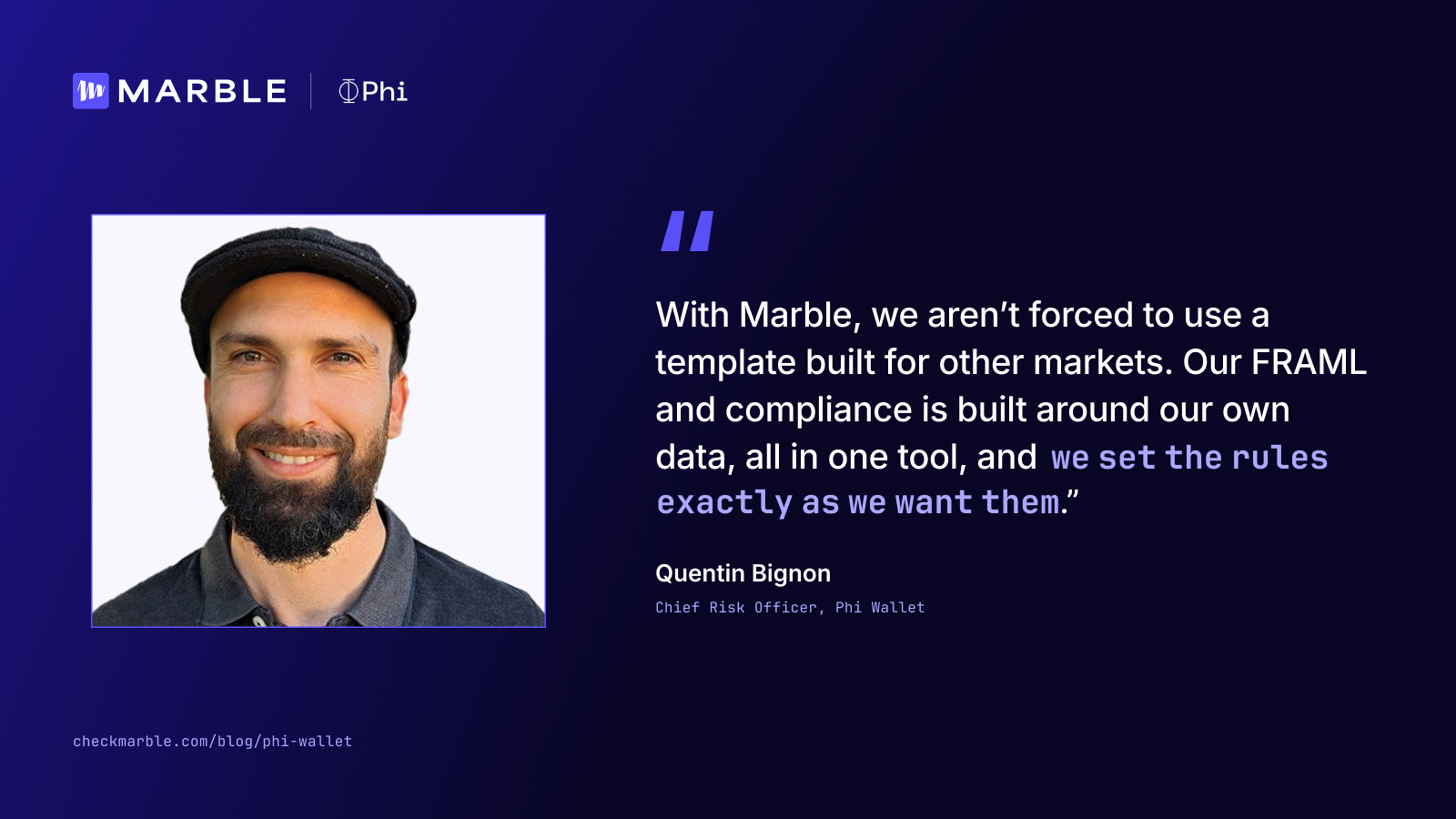
"Marble lets me run a much leaner team, because we have a 360-degree view of activity at transaction level. Whether you come from the AML angle or the fraud angle, it's all in one tool."
The alternative was excessively complex and time consuming. Quentin has seen other teams waste many hours and pour hundreds of thousands of dollars into internal tools to get this kind of flexibility. Phi Wallet got it at a much faster pace and spent their resources wisely.
A fully connected product: every new feature feeds the risk engine
A year in, Marble is no longer only Phi Wallet's monitoring tool. It has become the core its risk setup is built around.
It started with onboarding. Phi Wallet had built its own onboarding questionnaire and a risk scoring system that draws on it. When Marble's customer risk scoring went live, they simply brought those fields into Marble, so each one sharpened the other.
That is now the rule for every new feature: they simply feed Marble more context. More context means a clearer picture of the risk vector, and outliers that stand out sooner.
"When we design a new feature, I ask my engineering team how we can build an even better experience for our users utilizing Marble integrations. Because of its open-source nature and data flexibility, Marble is a tool that just grows on you for all the right reasons.”
The team behind the platform adds further value according to Quentin:
"We've always felt that Marble is very responsive, and very keen to support."
What's next: the full suite, with AI in its place
In his own estimate, Phi Wallet uses around 60 to 70% of Marble's features today. The next 12 months are about the rest: covering more FRAML and compliance needs inside Marble. AI is part of that plan, with people kept firmly in control.
Your data. Your rules. One connected risk engine. Watch a demo to see how Marble fits your framework.

Quentin Bignon