

“SaaS is fast and modern. On-premise is slow and outdated.”
Many infrastructure conversations start with this framing. For compliance, this is also the wrong one entirely.
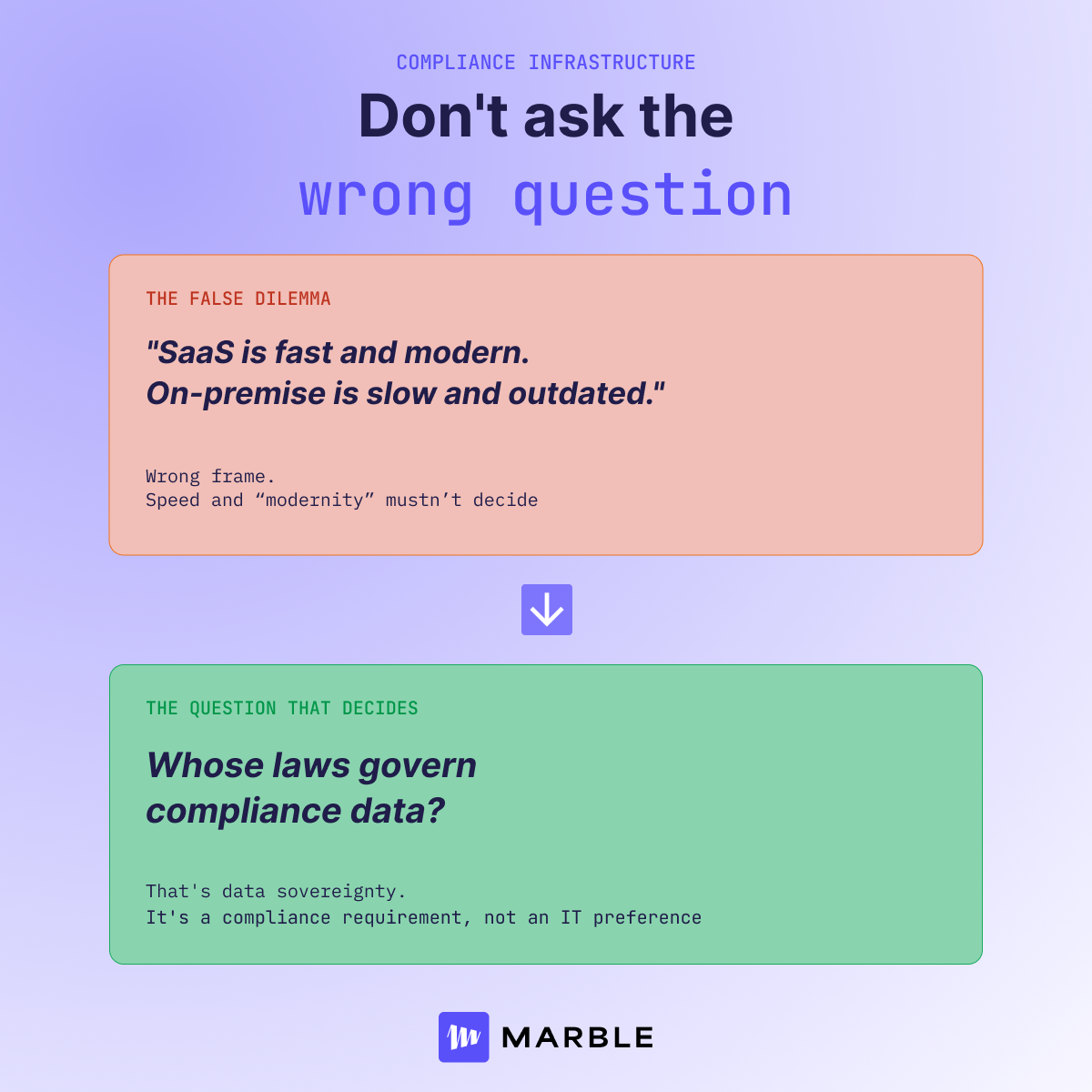
Data sovereignty isn’t a deployment preference – but a legal concept.
It determines whose laws govern your data, who can compel access to it, and what happens when those laws conflict across the jurisdictions you operate in.
Speed and modernity don’t enter into it. Jurisdiction does.
Key takeaways
– Data sovereignty – not deployment speed – is the right axis for evaluating compliance infrastructure
– Compliance and IT aren’t opposed here. They’re optimizing for different things that can be reconciled
– Deployment flexibility, access control, and platform transparency all flow from the same sovereignty requirement
– The right compliance platform fits your jurisdiction’s rules, not the other way around
What data sovereignty actually requires of compliance infrastructure
Data sovereignty means your organization’s data is subject to the laws of the jurisdiction where it’s stored and processed. (Sometimes, it’s called data residency, although the two terms have a precise difference – more on that below.)
For a compliance team operating across borders, this isn’t an abstract concern. It’s a daily operational constraint. Think of companies like a FinTech licensed in multiple markets, a bank with regional subsidiaries, a payments provider expanding into new territories.
A compliance platform that genuinely respects data sovereignty needs to satisfy several connected requirements at once:
- Control over physical location – where data is stored, processed, and backed up, with the ability to confine that footprint to specific jurisdictions
- Clear access boundaries – who can reach the data, from where, and under what authority, including the vendor’s own staff
- Auditable proof – a record that demonstrates compliance with sovereignty obligations, not just a contractual promise
- Architecture that can adapt – because regulatory requirements shift, and a platform locked into one deployment model can’t follow
None of these requirements live in isolation. They’re facets of the same underlying question:
who actually controls your compliance data, and can you prove it?
Why this becomes a tension between compliance and IT
Here’s where the false choice does real damage.
Product teams default to SaaS for good reasons:
- faster implementation,
- lower maintenance overhead,
- automatic updates.
None of that is wrong. It’s just optimized for a different problem than the one compliance is solving.
When a compliance officer raises a sovereignty requirement the conversation stalls. “This data cannot leave this jurisdiction.” “We need to be able to prove exactly where this data lives and who touched it.”
What product teams hear is: “you want the slower, harder-to-maintain option.”
Each side is answering a question the other didn’t ask.
The translation compliance needs to make is this: sovereignty isn’t a preference for friction. It’s a regulatory input. It constrains the architecture decision before product and IT trade-offs even apply.
Once this is framed correctly, deployment flexibility stops being a compliance-only ask and becomes a shared requirement. Because an architecture that can’t satisfy sovereignty obligations creates legal exposure. Product and IT inherit this too – at the very moment a regulator asks where the data went.
Data sovereignty vs. data residency: a distinction worth getting right
The terms get used interchangeably, but the difference matters when you’re making the case internally.
Data residency refers to where data is physically stored – a geographic or jurisdictional location, set as a matter of policy or contract.
Data sovereignty goes further: it means the data is subject to the laws of the jurisdiction where it resides. This includes laws that may compel disclosure regardless of where the company itself is headquartered.
A platform can meet a residency requirement – while still creating a sovereignty problem. For example, data can be stored in the right country – but the vendor’s home jurisdiction can compel access to that data anyway, through laws that follow the vendor rather than the data. For compliance teams in BRICS, GCC, and African markets in particular, this distinction is often the entire point of the conversation.
How deployment flexibility and transparency connect to sovereignty
Sovereignty is the requirement. Everything else is the mechanism.
Deployment flexibility – the choice between SaaS and on-premise, and the ability to switch. This exists also because sovereignty obligations differ by jurisdiction – and they can change over time. A platform that only offers one deployment model can satisfy sovereignty requirements in some markets and fail them in others. Flexibility isn’t the goal in itself. It’s what makes meeting the actual goal possible across every market you operate in.
Platform transparency – this connects to sovereignty in a less obvious but equally direct way. If you can’t inspect how a platform handles your data, you can’t actually verify your sovereignty posture – you’re just taking the vendor’s word for it. An auditable, inspectable foundation – potentially built on open-source architecture – turns a sovereignty claim into a sovereignty proof.
Both of these matter. Neither replaces the core requirement. They’re consequences of taking sovereignty seriously. Not separate priorities competing for attention.
Questions to ask before building or switching compliance infrastructure
Before any procurement conversation with IT and product, a compliance team should have clear answers to these questions – and should expect a vendor to answer them without hesitation:
- Where is the data processed specifically, and can that change without notice? Not just “which region” – which legal jurisdiction, and what governs any cross-border transfer.
- Who can access the data, including the vendor’s own staff? Under what authority? A vendor’s internal access policy is part of your sovereignty posture, not separate from it.
- What happens to the data on contract termination? Deletion timelines, residual copies, and backup retention all need clear, contractual answers – not assumptions.
- Can you switch deployment models without starting over? If a regulatory shift forces a move from SaaS to on-premise (or vice versa), does that mean migrating to a new system, or adjusting the same one?
- Can you independently verify the architecture, or are you relying on the vendor’s description of it? This is where platform transparency stops being a nice-to-have and becomes part of the actual compliance answer.
Bring these five questions into the conversation – the deployment discussion stops being about speed versus control. It becomes about which architecture actually satisfies the legal requirement everyone in the room is accountable for.
How Marble is built around sovereignty, not around a deployment default
Most platforms pick a deployment model and ask you to fit your sovereignty requirements around it.
Marble starts from the other direction:
the architecture adapts to what your jurisdiction requires, not the other way around.
Deploy wherever your obligations require it
Marble runs on an open-source core that supports both SaaS and on-premise deployment – with the ability to switch as your requirements change.
If a new market demands data stay within its borders, that’s an architecture decision Marble already supports – not a migration project, not a new headache.
Prove your sovereignty posture, don’t just claim it
Every action inside Marble is tracked, versioned, and timestamped in an unalterable audit log. Role-based access control (RBAC) and single sign-on (SSO) define exactly who can reach what. IP whitelisting restricts entry points further. Marble holds SOC 2 (Service Organization Control 2) Type II audits, giving compliance and IT teams a shared, independently verified answer to
“who can access this, and how do we know?”
Inspect the architecture yourself
Because Marble’s core is open-source, your team isn’t taking a vendor’s word for how data is handled.
The codebase is reviewable.
There are no closed layers standing between your sovereignty obligations and your ability to verify them.
Integrate without rebuilding your stack
Marble connects to existing systems and data models without requiring a redesign first. And it can go live a few weeks rather than months.
For IT, this means the sovereignty-driven architecture compliance needs doesn’t come at the cost of a disruptive implementation.
The result: compliance gets an architecture that actually satisfies its legal obligations. IT gets a platform that’s fast to deploy, easy to integrate, and doesn’t quietly become next year’s migration headache.
Same decision. Two problems solved.
Build infrastructure that answers the sovereignty question before it’s asked
The moment a regulator asks where your data lives and who can reach it, “our vendor handles that” isn’t an answer.
Data sovereignty deserves a direct, provable answer. One that compliance, product, and IT arrive at together – because the architecture was built to satisfy all of them from the start.
See how Marble’s infrastructure adapts to your sovereignty requirements →
Frequently asked questions about data sovereignty in compliance
What is data sovereignty in compliance?
Data sovereignty in compliance is the principle that an organization’s data is subject to the laws of the jurisdiction where it’s stored and processed. For compliance teams, this determines which regulators have authority over the data, what disclosure obligations apply, and how cross-border data transfers must be handled. It’s distinct from simply choosing where a server is physically located.
Why does data sovereignty matter for AML and fraud compliance?
Anti-money laundering (AML) and fraud compliance programs handle highly sensitive customer and transaction data, often across multiple jurisdictions with different legal requirements. A sovereignty failure – data accessible to the wrong jurisdiction’s authorities, or stored in violation of a local data protection law – creates direct regulatory exposure, independent of whether the underlying compliance program itself is sound.
What is the difference between data residency and data sovereignty?
Data residency refers to the physical or geographic location where data is stored. Data sovereignty goes further: it means the data is subject to the laws of the jurisdiction where it resides, including laws that may compel disclosure regardless of where the vendor or company is headquartered. A platform can satisfy a residency requirement while still failing a sovereignty requirement if the vendor’s home jurisdiction retains legal reach over the data.
Can SaaS compliance tools meet data sovereignty requirements?
Yes, but it depends entirely on the architecture, not the deployment model itself. A SaaS platform can meet sovereignty requirements if it offers jurisdiction-specific hosting, transparent and auditable access controls, and contractual guarantees about data handling and disclosure. The deployment model isn’t what determines sovereignty compliance – the underlying architecture and access governance are.
What questions should compliance teams ask IT and product about data sovereignty?
Compliance teams should at least ask: where exactly is data processed and can that change without notice; who can access the data, including the vendor’s own staff; what happens to data on contract termination; can the deployment model change without a full re-platforming project; and can the architecture be independently verified rather than taken on the vendor’s word. These questions translate a legal requirement into terms IT can evaluate directly.
