


Regulatory changes do not wait for internal approvals.
A new sanctions list. A revised PEP threshold. A fresh fraud pattern. Any of these can require an urgent rule update today. Yet most compliance teams are still filing IT tickets and are waiting for engineers… to make changes that should take less than an hour.
That dependency is not a minor inconvenience. It is a structural risk.
This guide explains how to break it:
- what a modern AML rule update platform makes possible,
- how to build an update compliance workflows that are both fast and defensible, and
- what to look for if your current compliance setup is holding you back.
Why legacy AML transaction monitoring creates rule update risk
When rule updates require coding resources, compliance teams lose direct ownership of the logic that shapes their monitoring program. Every urgent change becomes a negotiation over priorities, sprint cycles, and engineering bandwidth. The compliance function ends up reacting to risk on someone else’s schedule.
Fragmented tools, siloed rules, and disjointed data sources compound the problem:
- Operational delays: weeks of waiting leave a window of vulnerability wide open. Slow updates create dangerous gaps between policy and live detection
- Loss of control: compliance officers cannot adjust rules directly, leading to drift in screening accuracy and monitoring precision
- The false positive avalanche: outdated or poorly tuned rule logic floods analysts with noise and obscures real alerts – especially when sanctions lists change or risk appetite shifts
The consequences are real. The cost is not just operational. When regulators ask why a rule changed – or failed to change –, teams need documented evidence. “It was waiting in the development queue” is not a defensible answer. It won’t satisfy authorities.
The AML rule update workflow – without IT
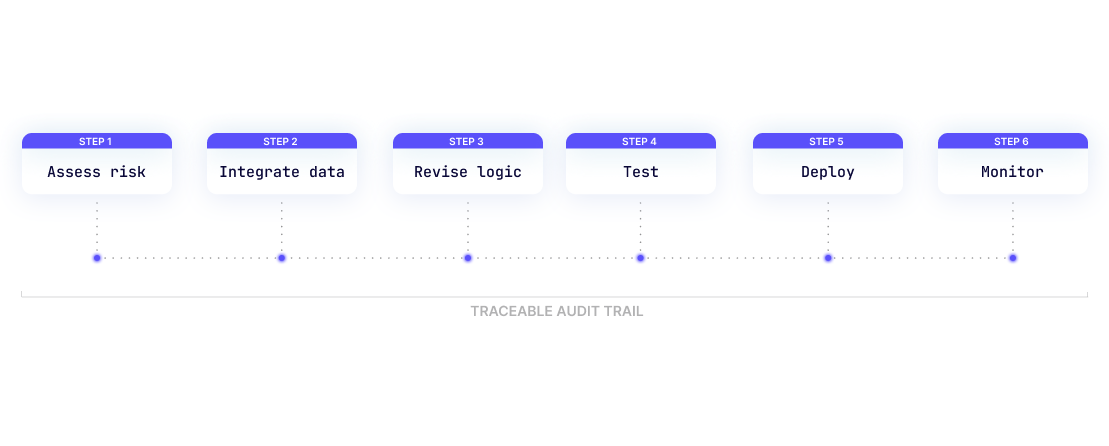
A well-structured AML rule update process keeps compliance in control at every step. Here is how a precise update process works:
- Assess the risk change
Identify what has shifted: a new sanctions list, a revised internal threshold, a pattern emerging from recent investigations. - Integrate the data
Connect the relevant data source – directly, through an API, or via the platform interface – without waiting for a data pipeline build. - Revise rule logic
Adjust thresholds, triggers, and conditions through a no-code interface. Complex aggregates and peer comparisons should be accessible without SQL. - Test before deployment
Run the new version against historical data or in a live simulation. Measure precision, compare false-positive rates, and iterate before anything goes live. - Deploy with controls
Role-based access ensures only authorized users can push changes. Version management keeps every deployment traceable. - Monitor and iterate
Track live performance, measure impact, and refine. Every change stays logged and searchable.
The golden rule: auditability is not a final checkpoint. At each step, there must be a clear record. Every version, every change, every deployment result must be registered. And every change should be easy to retrieve later.
The right AML rule update platform builds in that traceability right from the start. It doesn’t treat audit trails as an afterthought.
No-code compliance rules and compliance automation in practice
No-code does not mean simple. It means compliance teams can build rules as complex as they need. Aggregates, custom lists, peer comparisons, and AI-assisted filtering – without depending on an engineer in the room or vendor support. No fragile handoffs, fast cycles, full ownership of the logic. All through a clean interface.
Safe testing is not optional. An AML rule update platform must let teams A/B test scenarios against past data or simulate changes live without affecting daily operations. That is how compliance automation moves quickly without introducing risk.
Compliance AI takes this even further. AI surfaces anomalies, filters noise, and flags patterns that static rules miss. Your analysts stay in control of the decision. The platform handles the computation.
Core capabilities to look for in an AML rule update platform
When assessing any AML rule update platform, four things matter most:
- Direct ownership of rule logic: compliance teams build, update, and test rules themselves, with no engineering or vendor dependency
- No-code compliance rules with AI filtering: complex scenarios, aggregates, and false-positive reduction. All through a clean interface with no coding required
- A complete, unalterable AI compliance audit trail: every change, score, and decision logged, versioned, timestamped, and tied to a named user – to hold up under regulatory scrutiny
- A flexible, open data model: the platform adapts to your monitoring program and risk procedures, not the other way around
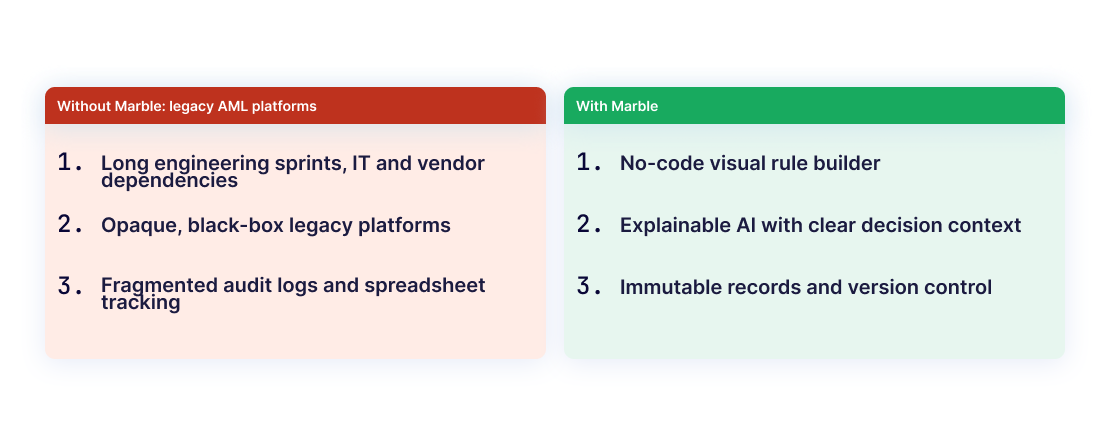
Legacy AML platforms fail on most of these. They create dependency, slow updates, and produce audit records that are partial at best.
How Marble’s AML rule update platform delivers speed and control
Marble is an open-source AML rule update platform built for banks, fintechs, and crypto exchanges that need full control over their compliance program. Teams integrate any data source, build complex monitoring rules through a precise no-code interface, and deploy updates without filing a single engineering ticket.
As our customer, Mirana Ratsimbason, Fraud Manager at Treezor put it:
“We can identify a fraud pattern at 9:00 AM and have a blocking rule live for everyone by 9:30 AM. That level of responsiveness is incredibly precious.”
On Marble, every alert arrives pre-analyzed, with a draft summary and suggested escalation steps. Marble’s AI Virtual Analyst handles the assembly work so your analysts focus on the decision – not on pulling data together. Every change is logged, versioned, and timestamped. Scenarios are tested before going live. Role-based access keeps compliance records clean and regulator-ready.
We implement Marble fast as SaaS or on-premise. The choice is entirely yours: Marble is built as the AML rule update platform that adapts to your requirements – not the other way around.
Explore Marble’s no-code AML rule update platform for real-time monitoring and rule-building, or the investigation and reporting features for audit-ready case workflows.
Fast and defensible – not a trade-off
Speed and auditability are not in tension on the right AML rule update platform. The question is whether your current setup gives compliance teams direct control – or whether every change still depends on a long cycle of requests, approvals, and manual documentation.
If your team is still waiting on engineers to update rules, you are not just slow. You are exposed.
Talk to a Marble compliance expert to see what compliance automation looks like when the team is fully in control.
